By Rajvi Mittal
Books are unusual products. And even if the monetary cost isn’t large, the reader is paying big time in trust and time commitment. When you think about it this way, it is easy to understand why readers would want some signal that the investment will be worthwhile.
A survey is one of those signals I think is extremely underutilized.
My story and context
In 2022, before I published my book of poetry, I set out to understand something important: How do people choose the books they read and buy? So I designed a short, focused survey of just 10 questions and sent it out to my old friends and future college mates. To my surprise, more than 50 people responded and many gave detailed responses. Two years later, when my book actually hit the shelves, so many of those people either bought the book or suggested it to their circles without my nudging, and continue to do so.
This is the result of delight in seeing someone live their dream and being a part of the journey from the beginning. People are much likely to support things that they contributed to in some way, even if it was small.
This is why you should bring people into your publishing and creative plans with a low-pressure survey. It is free, helps you start the conversation, leaves an algorithmic footprint, and has so many other understated benefits!
It makes you comfortable talking about your creative work
Ideas feel strong inside our own heads. A survey is a simple way of signaling to your brain: the audience matters.
In my experience, artists, writers, and first-time authors feel awkward asking people to read their stuff, let alone buy an entire book. Surveying is a low-pressure way to begin discussing themes connected to your creative work.
If you use it well, this would be a simple launch-pad to practicing explaining your ideas, sharing creative intentions, and talking about your inspiration — all without the pressure of selling.
Marketing reality: books don’t succeed from one social media post
Books are long-form content. They require more commitment than liking a post or watching a short video. And if the very first interaction someone has with your work is a purchase link, they are less likely to buy.
But if they have already seen…
- your thinking
- your questions
- your creative direction
- your seriousness
…then the purchase feels like a natural next step instead of a cold ask.
When people feel they are part of a community, especially if they have been around since your ‘early days’, they are inclined to support and champion your cause.
It helps identify friction points early
Sometimes small barriers prevent purchase of objectively brilliant work. In my own experience of surveying and subsequent publication, I realized that the general population, even frequent readers:
- don’t know what occasion to buy poetry for
- assume poetry is too difficult for them to understand (this sentiment is surprisingly widespread)
- don’t know how to judge a poetry book (hence go for the big names only)
- feel it is pretentious to engage in ‘poetry’
That’s specific to poetry, but you get my point. Small angles of awareness like these can help you avoid obstacles to selling your book.
Your book is competing for attention, not just literary appreciation
If you are a bibliophile like me, you probably grossly overestimate the amount of ‘reading’ that an average person gets around doing in real life.
But, for the average reader:
- reading competes with many other forms of attention
- reading requires uninterrupted time
- reading is mood-dependent
- reading is often aspirational (“I want to read more”) but not always frequent
- reading is sometimes seasonal (holidays, travel, life transitions)
People may genuinely appreciate and want to read your work. They may also be balancing work, doom scrolling on social media, managing unannounced fatigue, other hobbies and heaven knows what else. Understanding this prevents you from misinterpreting slow uptake as rejection. Sometimes it is not about you or your creative potential at all.
(chart screenshots from my survey)
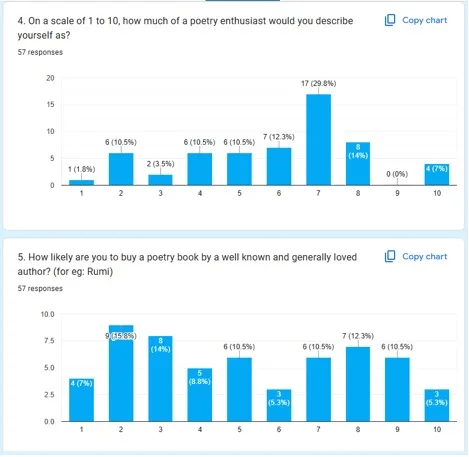
Doorway to learn how readers describe their preferences in their own words
Friends and peers would give you the exact terms used by people who only read occasionally i.e., everyday language, like:
- “I buy books when someone I trust recommends them.”
- “I prefer short reads because I don’t have time.”
- “I like books I can gift.”
-
“I save poetry for when I want to feel something specific.”
Take this information and use it to shape your book blurb/descriptions, marketing/positioning copy, and social media communication. You’d come across as an author who understands readers – not just shouts at them from a high horse.
How to survey
People tend to respond when surveys are low effort, friction-free and do not trample over their personal privacy. Keep confidentiality, ease, skippability at top of your priority. I like using Google Forms as it exports the result into Google sheets and gives results in clear charts.
Steps to create a Google Form survey:
- Start: Use a standard template or create a blank form on forms.google.com.
- Add content:
- Title and description: Click on “Untitled form” to give your survey a name and add a description for context (keep it conversational for building rapport).
- Add questions: Click the “+ ” button to add new questions, choosing types like Multiple choice, Paragraph, or Dropdown.
- Customize: Use the palette icon to change the theme, header image, and colors. (No worries if you keep it simple.)
- Configure settings:
- Required questions: Toggle the “Required” switch to make important questions mandatory. (Don’t keep too many of these; I’d suggest to not make open-ended questions mandatory, give people choices to select instead; aim to reduce friction.)
- Collect emails: Go to Settings to limit responses to one per person or collect email addresses. (It might deter people from giving you a response at all, so consider making this non-mandatory.)
- Collecting names: (People become conscious when they feel watched; consider making this non-mandatory or encourage anonymous naming.)
- Number of pages: Keep to a minimum. I suggest a crisp page. You never want to make a reader overwhelmed just filling your Google form.
- Send and analyze:
- Preview: Click the eye icon to see what respondents will experience.
- Share: Click the “Send” button at the top right to share via email, link, or embed the form.
- Review responses: View answers under the “Responses” tab, where you can see summary charts.
Takeaways for authors
When you are looking to break into the world of commercially successful publishing, it helps if you know how people, in general, talk about reading; and one way to understand this is by talking to the average reader.
A survey can break your assumptions, throw light on your potential blind spots and force you to face the squeamish feeling that comes when asking people to pay for your work (aka sales).
It also builds an ongoing conversation between you and potential readers – instead of you randomly showing up and asking people to buy a long form like a BOOK. Having a digital trail of process and thought does wonders for credibility and community.
Even if the survey responses do not directly shape any of your content, the gesture itself communicates respect. People appreciate being considered.
Finally, a survey is useful early content because it:
- helps the project feel real
- reduces uncertainty about the publishing landscape
- invites interaction (good for the algorithm)
- encourages people to participate
- signals seriousness of intent (for future work)
- builds early connection with readers
- creates curiosity (“what are they working on?”)
- creates momentum before launch
- creates a memory marker (“oh yes, this person has been working on something for a while”)
What authors should not take from this
Surveying, however, does not mean: write what people demand / follow trends blindly / optimize creativity into blandness. It simply means understand the landscape you are entering. Surveying your own circle does not give statistically perfect market data. What it does give is: direction, language, confidence, and awareness of reader behaviour.
Parting note
Take heart in the fact that reading enthusiasm ≠ reading frequency. People appreciate books, respect authors, enjoy literature, value thoughtful writing, but often read less than how much they’d like to. Your creation has merit, whether or not someone reads/ buys it.
But if you aim at generating money from your writing, you have to understand this basic fact: you are a seller. This is a marketplace. The readers are potential customers. The laws of business and commerce apply impersonally.
Bio: Rajvi Mittal is a multi-passionate author and artist from India. She has self-published a poetry chapbook titled “Reborn: Darkness is the Seed of Light” and writes a LinkedIn newsletter ‘SnowFlames Weekly’. Her writing has been published in McSweeney’s Internet Tendency, Entrepreneur Magazine and other online blogs. Her photography & artwork is forthcoming in Blood+Honey, and Flash Frog Lit Magazine. She made a career transition from a corporate consultant to support her health and is now a freelance artist. Her merch is available at her Etsy shop, Phoenix Rising Creations.